
Average IQ of a Mathematician: What the Evidence Shows

You have probably seen a confident number attached to this question: "mathematicians average 130," or even 150. It sounds plausible, which is exactly why it spreads. The honest answer is less tidy. The average IQ of a mathematician has never been measured in a large, representative sample, so any single figure you find online is, at best, an estimate and, at worst, a guess.
That does not mean the question is empty. Mathematicians do tend to score well above the general population on tests of reasoning, and there is real research on why. This article walks through what is actually known, which numbers you should ignore, and what an IQ score can and cannot say about someone who does mathematics for a living.

Is there an official average IQ for mathematicians?
No. There is no census of mathematicians' IQ scores, and no major study has tested a representative group of working mathematicians on a full-scale intelligence test such as the Wechsler scales. IQ tests are scaled so that the general population averages 100, with a standard deviation of 15. Anything said about a profession's average has to come from somewhere else, and in most cases it comes from nowhere.
Here is how the common sources of mathematician IQ numbers stack up:
| Source of the number | How reliable is it? |
|---|---|
| Listicles and forum posts quoting "130," "143," or "150" | Very low. These almost never link to a study, and the figures are copied from site to site. |
| Small academic comparisons of a few dozen mathematicians | Useful for patterns, too small to give a population average. |
| Graduate admission test scores by field | Indirect. They measure test performance, not IQ, among people who chose to apply. |
| Long-term studies of mathematically gifted children | Strong evidence about talent and later careers, but not an average for the profession. |
If a page gives a precise average, such as 143 or 147, treat that as a warning sign rather than a fact. A precise number needs a precise source, and these pages rarely have one.
What the data does show
Math-heavy fields rank near the top on ability tests
The closest thing to a large-sample comparison comes from graduate admission testing. Psychologist Jonathan Wai, writing in Psychology Today, averaged the quantitative and verbal GRE scores of test-takers by intended graduate field to estimate general ability. In that ranking, engineering came first and math and computer science came second, ahead of the physical sciences, biological sciences, humanities, social sciences, business, and education.
Read that carefully, though:
- It ranks groups. It does not give an IQ for any of them.
- Only people who chose to take the GRE are included, so the sample is selected.
- The groups overlap heavily. Plenty of people in lower-ranked fields outscore plenty of people in higher-ranked ones.
- The post dates from 2011, and the author notes that whether the GRE measures general ability still needs to be demonstrated.
So the fair summary is that people headed into mathematics tend to score high on reasoning tests as a group. That supports "above average." It does not support any specific number.
Early math talent predicts later achievement
The strongest research on mathematical ability comes from the Study of Mathematically Precocious Youth, founded at Johns Hopkins in 1971. It identified young adolescents with exceptional SAT math scores and followed them for decades. A 2006 review by David Lubinski and Camilla Persson Benbow in Perspectives on Psychological Science drew on more than 5,000 participants across five cohorts. Its main message is that mathematical ability, along with strong spatial ability and investigative interests, marks out a promising profile for later success in science and mathematics.
Two points matter for our question. First, this is evidence that ability is one ingredient, not the whole recipe. Second, the review also points to interests and educational opportunities as part of the picture. A high test score opens doors, but it does not walk you through them.
Ready to discover your IQ?
Take our scientifically designed test and get your score in just a few minutes.
Why a single number misleads
"Mathematician" covers very different people
A pure mathematician proving theorems, an actuary pricing insurance, a statistician running clinical trials, and a high school math teacher all have mathematical training. Their work, their entry requirements, and their test profiles differ. One average cannot describe all of them, and a research mathematician at a top department is not a typical sample either.
Selection effects do the heavy lifting
Reaching a doctorate in mathematics takes years of study and repeated filtering through exams and admissions. By the time someone is a professional mathematician, a lot of selection has already happened. That is why mathematicians as a group look strong on reasoning tests. It is also why you cannot reverse the logic and say that a particular IQ score will make someone a mathematician.
IQ is only part of what mathematicians do
Mathematical research rewards persistence, curiosity, comfort with being stuck, and a taste for what is worth proving. Strong reasoning helps, but so do the things a test score does not capture, and no study has shown how much each contributes.
Famous mathematicians and IQ claims
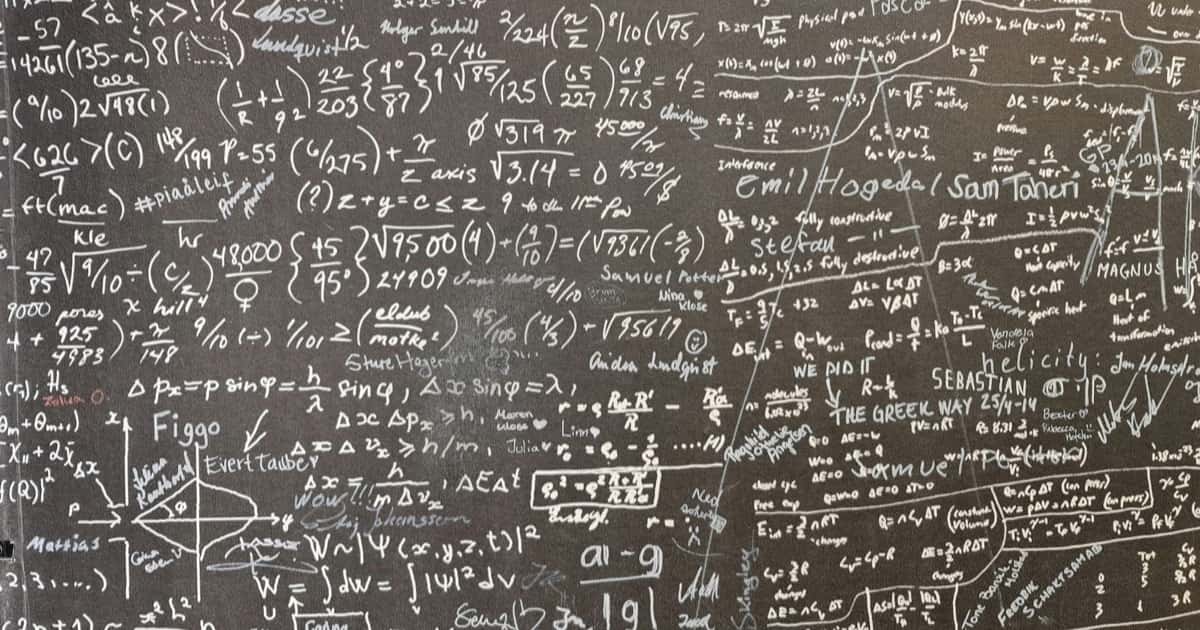
Lists of "mathematician IQs" usually include figures like Gauss, Euler, or modern Fields Medal winners with confident-looking numbers. None of these people sat a modern standardized IQ test in a way that produced a trustworthy score. Where a number exists, it is usually a retroactive estimate or an internet rumor. A better habit is to judge mathematical talent by what people actually did: the proofs, the problems solved, the students taught. Those are things you can check. A number attached to a name usually cannot be checked.

What this means if you are curious about your own score
Being good at math does not mean your IQ is any particular number, and struggling with math does not cap your score either. IQ tests sample several kinds of reasoning, and mathematical skill depends heavily on training, practice, and confidence. Plenty of people with strong overall reasoning dislike formal math, and plenty of skilled mathematicians would call themselves average at other tasks.
If you want a rough sense of where your reasoning sits, an online test can give you a general idea, but it is not a clinical assessment and should not be read as a diagnosis or a verdict on your abilities. For a formal result, you would need an assessment administered by a qualified professional.
Summary
- There is no measured average IQ for mathematicians, and precise figures online are rarely traceable.
- Graduate test data suggests math-heavy fields attract high scorers on reasoning tests as a group, with large overlap between fields.
- Research on mathematically gifted youth shows ability matters, along with interests, opportunity, and sustained effort.
- Selection, not just raw talent, shapes who ends up in the profession.
- Judge mathematicians by their work, not by a rumored number.
Frequently Asked Questions
Q: What is the average IQ of a mathematician?
A: No reliable figure exists. Mathematicians tend to score above the general average of 100 on reasoning tests as a group, but no large study has measured a representative sample. Numbers like 130 or 150 usually have no traceable source.
Q: Do you need a high IQ to be good at math?
A: Not a specific number. Reasoning ability helps, but math skill also depends on teaching quality, practice, curiosity, and persistence. Test scores alone do not set the ceiling.
Q: Are mathematicians smarter than physicists or engineers?
A: The data does not support a clear winner. In the GRE-based ranking discussed above, engineering ranked first and math and computer science second, and individuals overlap heavily across every field.
Q: Was the IQ of Gauss or Terence Tao ever measured?
A: Not in a way that gives a trustworthy score. Historical figures such as Gauss never took modern IQ tests, and numbers quoted for living mathematicians are usually rumors or estimates, not verified results.
References
- Psychology Today — How Brainy Is Your Major?
- Lubinski & Benbow (2006) — Study of Mathematically Precocious Youth After 35 Years: Uncovering Antecedents for the Development of Math-Science Expertise
- MedlinePlus Genetics — Is intelligence determined by genetics?
Last updated: November 20, 2026
Ready to discover your IQ?
Take our scientifically designed test and get your score in just a few minutes.
